
Quick answer: what can an AI phone agent do for a small business?
It can answer approved questions, collect the request, and route the call to a person. It should say an appointment is booked only after the calendar confirms it. The phone provider, the rules, and the tests decide what it can actually do.
Which missed calls should you automate first?
A plumber under a house or a busy front desk cannot always answer. That does not mean every call needs a fully automatic system. Review a sample of real inquiries, separate routine from urgent, and then choose a voice agent, a missed-call text, an answering service, or better coverage.
A plumber working under a house, an HVAC technician on a rooftop or a repair shop with a busy front desk can't always answer immediately. That doesn't automatically mean the business needs a fully autonomous phone system. It may need a more reliable first response, a way to capture useful details, or an after-hours process.
Start by reviewing a sample of genuine inquiries. Which call types are routine, which require trained judgment, and which are urgent or sensitive? The answers determine whether you need an AI voice agent, a missed-call text-back workflow, a conventional answering service or better team coverage.
What one job should the phone agent have?
Start with one call type, such as new-customer requests after hours. Write the greeting, the services, the real service area, and how to reach staff. Also write what it must not do: unauthorized prices, safety diagnoses, arrival promises, or payments without an approved secure workflow.
A good pilot might handle new-customer appointment requests after business hours. It should know the approved greeting, business name, offered services, actual service areas, office hours and how to contact staff. If you promise “24/7 answers,” define which answers are supported rather than implying a human is available around the clock.
Document what the agent must not do: quote unauthorized prices, diagnose a safety-critical situation, promise an arrival time, impersonate an employee or accept payments without an expressly approved secure workflow.
How should an inquiry reach a person?
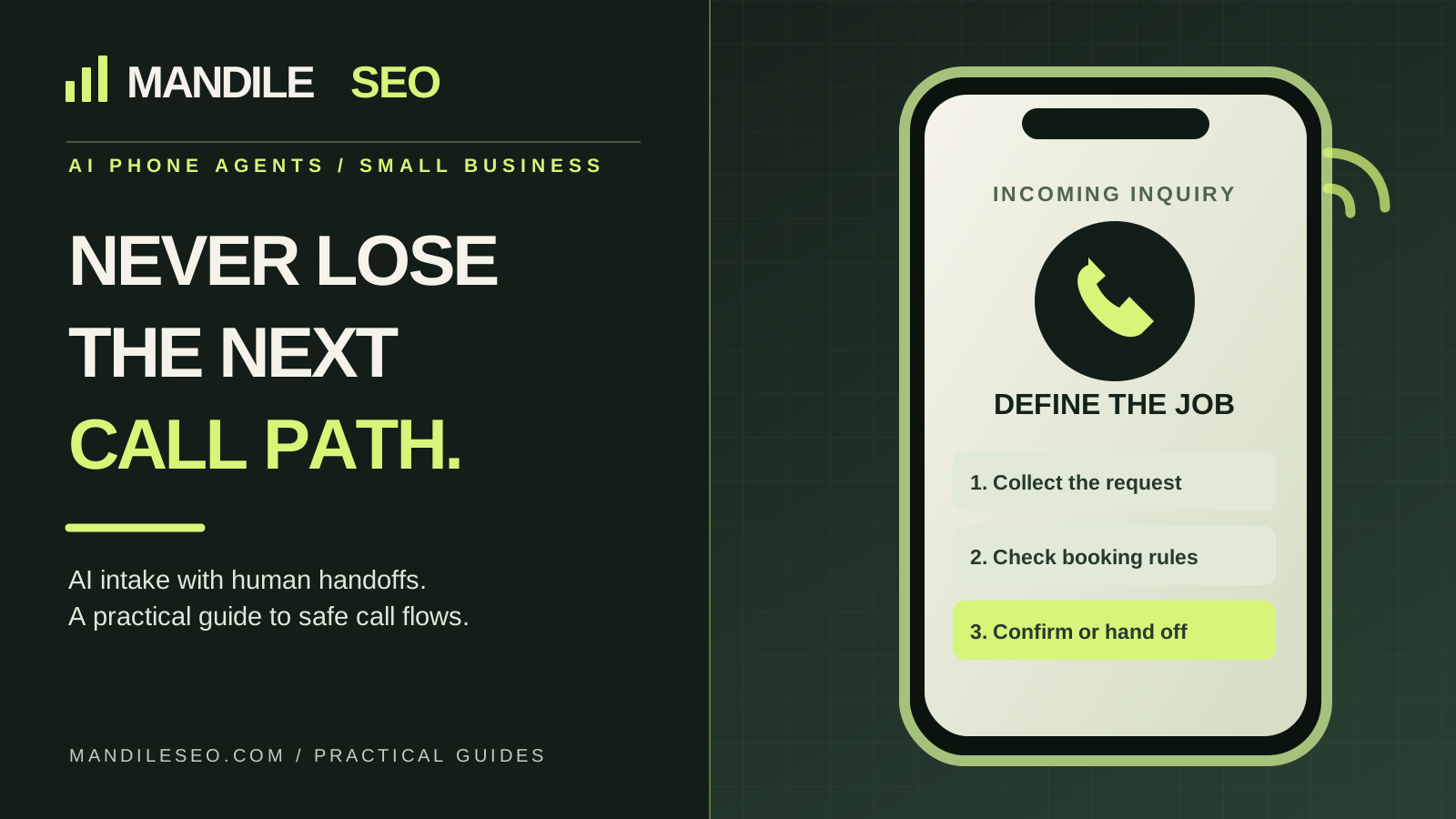
The flow below is illustrative, not a claim that a client system is already live. Identify the request, use only approved information, collect the minimum details, and confirm a time only if the connected system verifies it. If an integration is down, the system should fail safely.
The following workflow is illustrative. It is not a claim that any specific client system is already deployed or that every phone platform supports these steps.
Incoming call → Identify the caller's request → Provide only approved information → Collect minimum useful details → Check booking or routing rules → Confirm an appointment only if the connected system verifies it, otherwise request follow-up → Transfer or escalate when needed → Save an authorized record for the team.
Each arrow represents a decision that needs explicit rules. A business may skip booking entirely and simply collect a message. A responsible system should fail safely when integrations are offline.
Where should the agent get business information?
Use one reviewed source for services, hours, service area, booking rules, and escalation contacts. If the website and the calendar disagree, fix the facts before the agent speaks. A roofing company that takes leak calls but not every repair should say that difference out loud.
Use a reviewed source of truth: the approved services, hours, service area, booking rules and escalation contacts. If the website says one thing and the calendar or operations manual says another, reconcile the discrepancy rather than letting the agent improvise.
For instance, a Phoenix roofing contractor may take emergency leak requests but not perform every type of roof repair. The call agent should distinguish those services accurately, including when it must ask an employee to confirm availability.
What counts as a real booking?
Tuesday afternoon sounds good is not a booking. A real booking needs an authorized calendar check, the appointment type, the time zone, and a confirmation. If a person must screen the caller first, say a request was submitted. Test duplicates, overlaps, and outages so there is no phantom calendar entry.
Capturing “Tuesday afternoon sounds good” is not the same as booking an appointment. If the agent integrates with an authorized scheduling system, document availability checks, appointment types, time zones, confirmation messages, cancellation rules and what happens when no slot is available.
If a customer must be screened by a human before scheduling, the system should say a request was submitted rather than an appointment confirmed. Test duplicates, overlapping appointments, double-booking and outages.
When should a person take over the call?
Human handoffs are part of the product. Transfer emergencies, billing disputes, frustrated callers, and anything outside the approved script. The transfer needs a working number. If nobody answers, leave a message or a queue with an honest wait. Do not loop the caller with a promise that help is coming.
Human handoffs are part of the product, not a failure. Define triggers for emergencies, unusual technical requests, frustrated callers, billing disputes, sensitive personal information and anything outside the approved knowledge base.
A transfer should go to a working contact method. If nobody answers, use a fallback such as a message, queue or notification with an honest response expectation. Avoid endless loops that repeatedly tell the caller help is coming.
What privacy, recording, and consent rules apply?
Tell callers they are speaking with an automated system, and explain recording when it applies. Recording, consent, texting, and retention rules vary by place, so get advice for the workflow you will actually run. An inbound call does not by itself authorize promotional texting.
Tell callers when they are speaking with an automated system and explain recording practices when applicable. Review the laws and platform policies that govern call recording, consent, automated calls, texting, retention and handling of personal information in the places where your business and callers operate. Requirements vary by jurisdiction; get qualified legal advice for the specific workflow.
Collect only information needed to respond to the request. Clarify who can see call transcripts, how long records are kept, where recordings are stored, and how a customer can request correction or deletion where applicable. An inbound call does not by itself authorize promotional texting.
What should you test before customers rely on it?
Do not judge the setup only by a smooth demo. Test routine requests, unavailable times, urgent calls, unknown prices, a calendar that is offline, and a caller who asks for a person. The owner should approve the facts and the steps the agent may take.
Don't judge a pilot only by whether the first demo sounds natural. Test real paths with permission, including errors and uncertain requests. Ask the owner to approve the business facts and the specific steps the agent may take.
| Test call | Expected behavior | What to verify |
|---|---|---|
| Routine new inquiry | Collects approved details and explains the next step | Correct CRM record or notification |
| Request for unavailable appointment | Doesn't claim a booking; offers a follow-up path | No phantom calendar entry |
| Urgent or safety-related request | Follows approved escalation rules; does not provide dangerous advice | Correct transfer/fallback |
| Unknown service or pricing question | Says it cannot confirm and offers a human response | No invented quote or service promise |
| Calendar or CRM offline | Explains the limitation and records a safe fallback | No lost or duplicated lead |
| Caller wants a person | Attempts an authorized handoff without resisting | Working transfer number and fallback |
What should you measure besides calls answered?
Count calls handled, inquiries categorized correctly, successful transfers, confirmed appointments, missed follow-ups, and errors. Compare them with a baseline you wrote down. An answer rate that creates extra cleanup is not a better outcome. Do not borrow an industry percentage as your result.
Track the total calls handled, correctly categorized inquiries, successful human transfers, confirmed appointments, missed follow-ups, errors and owner review notes. Compare with an honest baseline. If the agent generates extra support work or confuses customers, its apparent answer rate may look better than the actual business outcome.
Separate a **pilot's technical results** from estimates of revenue or time savings. Savings and conversions should be calculated from real measurements rather than borrowed industry percentages.
Should you use a receptionist, a text-back, or a person?
A voice agent can hold a defined conversation. Missed-call text-back follows an unanswered inbound call. A human answering service fits judgment-heavy requests. Many shops use a mix. Do not force a voice system on a business that only needs a simpler way to capture the lead.
These options solve overlapping but different problems. A voice agent can support defined conversations; missed-call text-back may follow up when a real inbound call goes unanswered; a human answering service may be more appropriate for judgment-heavy requests. A hybrid often works better than replacing every call with AI.
For a contractor who gets most calls while driving or working on equipment, start by asking which inquiries need an immediate live conversation and which can wait for a reply. Don't force a voice system on a business that only needs a simpler lead-capture path.
What should you ask an AI phone-agent provider?
Ask which call types stay human, where the approved facts live, whether the calendar can really confirm a time, where recordings go, how consent and recording are disclosed, and what happens when the phone or CRM is down. Setup, usage, and support should be separate line items.
- Which specific call types will be automated, and which remain human-owned?
- What approved information can the agent use, and who updates it?
- Can the system truly check availability and confirm booking in our calendar?
- Where do caller details go, and can we access or export them?
- How does the system disclose automation, handle recording rules and honor consent?
- What is the fallback when the internet, telephony or CRM integration fails?
- How will we test and review errors before switching on live traffic?
- What subscriptions, usage fees and ongoing support are separate from setup?
People also ask: AI phone agents for small business
Can an AI receptionist book appointments?
Sometimes, and only when booking is in the written scope and a compatible calendar has been tested. A caller saying Tuesday afternoon sounds good is a request, not a confirmed booking. The agent should say the appointment is booked only after the calendar confirms it.
Will an AI phone agent replace my employees?
That should not be the goal. A sensible setup handles defined routine calls and connects the caller to a person for emergencies, billing, or anything outside the approved script. Human handoffs are part of the product, not a failure mode.
Do I have to change my CRM or phone provider?
Not always. It depends on the current phone system, permissions, APIs, and routing. Confirm the integration before anyone says the agent can write to the calendar or the CRM you already use. Failed connections still need a tested fallback path.
What should the agent be allowed to say?
Only approved information: services, hours, service area, and how to reach a person. It should not invent a price, diagnose a safety issue, or promise an arrival time. If the caller wants a person, the transfer should go to a working number.
How is AI phone handling priced?
AI phone handling is a custom scope, quoted in writing before work starts. Phone service, usage, and third-party tools are listed separately. It is not the $1,000 local SEO setup or the $497 Signature Website. Answer rates and bookings are not promised.
What happens when your business misses a call?
Tell me what kinds of inquiries arrive, who handles them now, and what tools you already use. Call 971-446-5221. Mandile SEO, 5836 W Thunderbird Rd, Glendale, AZ 85306. Setup, usage, and support are quoted before work begins. Bookings are not promised.