
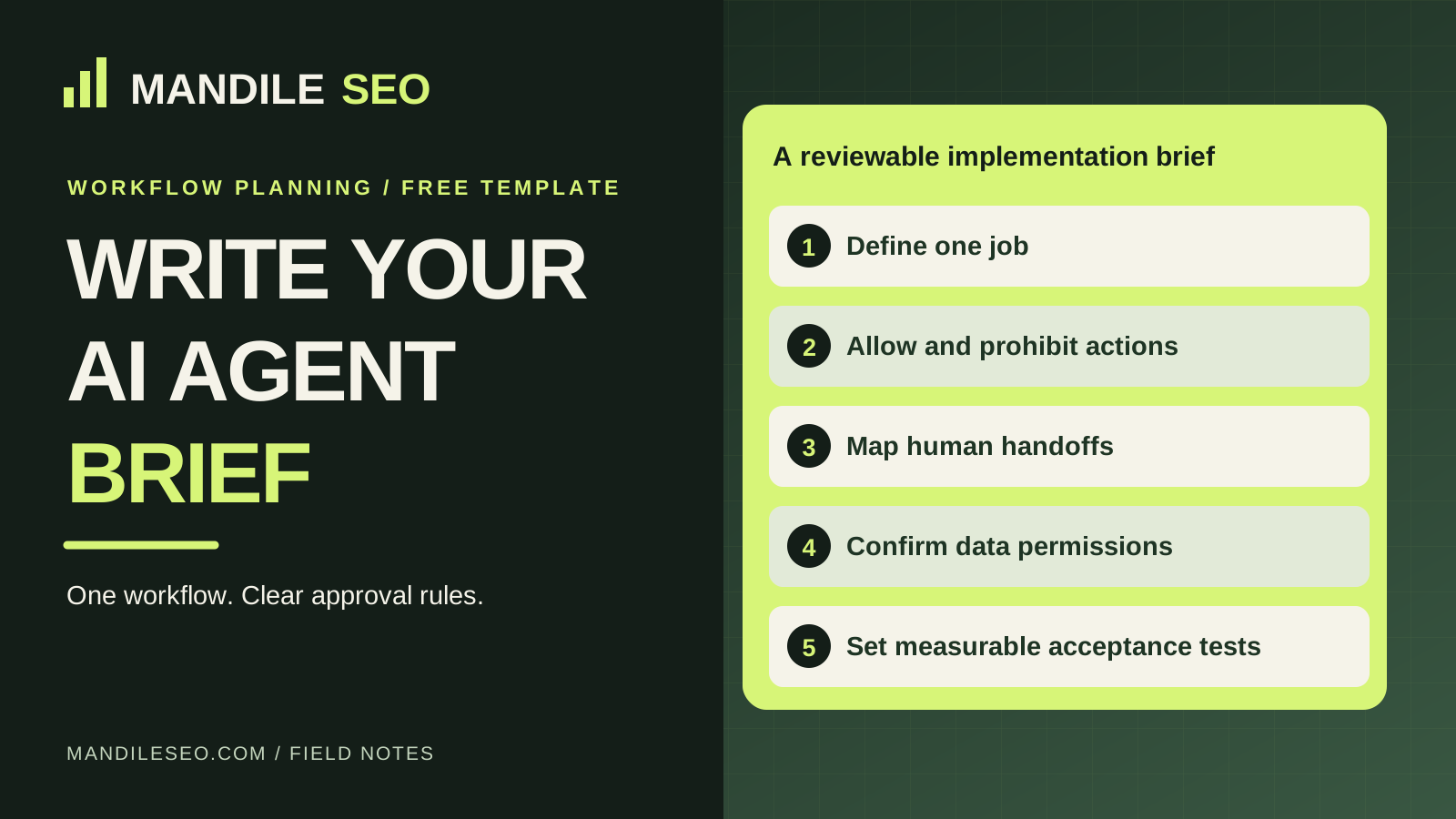
Quick answer: What goes in an AI agent implementation brief?
Write one job, the trigger, allowed and forbidden actions, the handoff, and the tests. The owner reviews the brief before any live system is connected. The template is not a deployed agent.
Copy this seven-part AI agent brief template
Copy the business context, one job, allowed actions, forbidden actions, escalation, data rules, and acceptance tests. Fill the brackets with real facts. Leave a bracket blank rather than inventing a price, a booking, or a promise the business has not approved.
- Business context: [business name], [service area], [workflow owner], [hours], [source of truth].
- Single job: When [trigger] occurs, receive [input], perform [approved steps] and deliver [output].
- Allowed actions: [approved FAQs], [specific fields collected], [authorized routing or requests].
- Forbidden actions: [custom quotes], [diagnoses], [unverified bookings], [payments], [unsupported promises].
- Escalation: If [safety warning, unknown question, caller requests human], transfer to [staff channel]; if unavailable, follow [fallback].
- Data: [minimum collection], [consent/disclosure], [retention], [access rights], [export and deletion policy].
- Acceptance criteria: [normal path], [outage], [double-booking], [unknown request], [handoff], [privacy check], [owner approval].
What does an after-hours plumbing brief look like?
This example only collects the name, callback number, issue category, service area, and an urgency flag. A person decides dispatch. The workflow must not diagnose a gas leak, promise an arrival, quote a repair, or say a technician is scheduled. Completion is a request, not a visit.
Illustrative only: A plumbing business wants to collect after-hours service requests. Approved steps capture customer name, callback number, broad issue category, service area and an urgency flag. A human determines dispatch and availability.
The workflow must not diagnose gas leaks or electrical hazards, guarantee an arrival time, quote a repair or claim that a technician is scheduled. An immediate emergency should receive approved safety escalation language directing the caller to appropriate emergency services where necessary.
Completion means a valid request reaches an authorized team member and can be acknowledged. It is not a booked visit until a connected calendar or staff member confirms it.
What should the owner verify before launch?
The owner checks the name, hours, and answers, signs allowed and forbidden actions, and confirms the phone, CRM, and calendar against the vendor docs. Human transfer and fallback are tested. No confirmation goes out until a booking is verified. The owner approves any live step.
- Owner verifies business name, service areas, hours and FAQ answers.
- Allowed and prohibited actions are signed off.
- Phone, CRM and calendar capabilities are checked against real provider documentation.
- Human transfer and fallback are tested with realistic scenarios.
- No confirmation is sent until bookings are verified.
- Data access, recording disclosure, consent and retention are reviewed.
- Owner tests draft outputs and explicitly approves any future live deployment.
What should the owner actually measure?
Count events you can see: a message in the right queue, a completed transfer, a correct classification, a confirmed booking, and the failures. Do not turn a guess about saved time into revenue. A quote and a paid invoice are different numbers.
Define an observable event for each workflow: message delivered to the authorized queue, call transferred successfully, correct classification, confirmed booking, or false-positive response. Count failures, too. Do not convert estimated time savings into guaranteed revenue.
What does a preview-only builder produce?
A preview can export a scope brief, a knowledge template, a sample script, and a test checklist. It does not configure a real number, invent facts, place live calls, or certify compliance. A completed brief is not a working or deployed AI agent until the owner connects systems on purpose.
| Export | What it contains | What it does not do |
|---|---|---|
| Editable scope brief | Business facts, workflow and approvals | Configure a real number or CRM |
| Knowledge template | Approved service questions and answers | Invent facts from web pages |
| Call or intake script | Sample routine and escalation branches | Place or answer live calls |
| Acceptance-test checklist | Owner review and go-live gates | Certify legal compliance or guarantee behavior |
What should you do after the brief is reviewed?
Choose a product whose real integrations match the brief, then get a written quote for usage and maintenance. Sandbox tests come before any live switch. The preview document is not consent to record calls, contact customers, or start a marketing list.
Choose a product or developer whose actual integrations can meet the requirements. Get a written quote including usage and maintenance. Only then plan limited sandbox testing and permissioned production activation. The preview-only document is not consent to record, contact or market to customers.
People also ask
What goes in an AI agent implementation brief?
One job, the trigger, the approved data, the allowed and forbidden actions, the escalation path, and the tests. The owner reviews it before credentials or live systems are connected. Copy this seven-part AI agent brief template and leave unknown facts blank.
Is the template a working agent?
No. A completed brief is not a working or deployed AI agent. It does not answer calls or write to a CRM. Live use starts only after the owner approves a tested connection. The graphic is a planning worksheet.
Can the brief promise a booking?
No. Never call a request a confirmed booking unless a calendar or a staff member has confirmed it. The plumbing example collects a request. A person decides dispatch and availability. Arrival times stay out of the script.
What should prelaunch tests cover?
The normal path, an outage, a double-booking attempt, an unknown request, and the human transfer and fallback. Recording disclosure and consent are part of that review. The owner signs the results before any live deployment.
How is this priced?
AI agents are a custom scope, quoted in writing, with usage and third-party tools listed separately. The template itself is a planning aid on this page. It is not a quote and it does not start an implementation.
Have your implementation brief reviewed?
Send the draft workflow and existing tools. Mandile SEO can scope a focused pilot with explicit human approval, realistic operating costs and prelaunch checks. Call 971-446-5221. Mandile SEO, 5836 W Thunderbird Rd, Glendale, AZ 85306.